AI has changed the IT market and the demand for skilled Software & AI engineers will constantly rise. Lead the race.Explore our AI aligned courses ↗
ALGORITHMS & CONTEST STRATEGY

Competitive Programming.
To Crack Top Product Companies

Go beyond familiar DSA problems. Learn the algorithmic patterns, contest strategy and discipline to solve unfamiliar challenges under time pressure.

Intermediate → Advanced Live online
  • Contest foundations
  • Algorithmic patterns
  • Contest strategy
ENQUIRE ABOUT THE COURSE

Your next chapter
starts here.

Tell us a little about yourself.

I’m a

YOUR STARTING POINTDSA fundamentals
YOUR ROADMAP11 learning modules
COURSE DURATIONBatch-specific
YOUR LEARNING MODELive online
A FOUNDATION THAT TAKES YOU FURTHER

Understand the problem.
Own the solution.

Build more than familiarity with syntax. Learn how to approach an unfamiliar problem, reason about your choices, and turn your thinking into working code.

Know your DSA? Time to compete.

For students comfortable with C++ and core data structures who want to solve harder, unfamiliar problems on Codeforces and in contests.

Read the constraints

Translate input limits into a viable algorithm, and know when brute force is enough and when it is not.

Recognise the pattern

Apply reusable approaches, from binary search on the answer to segment trees and DP, to problems you have never seen.

Compete with consistency

Build speed and reasoning through practice contests, then upsolve to turn every miss into progress.

YOUR LEARNING ROADMAP

One concept leads
to the next breakthrough.

Move from contest foundations to the patterns behind faster solutions. Build the algorithmic thinking to understand, debug and improve code—even when AI helps write it.

FOUNDATIONS FOR THE AI ERA

Stronger fundamentals. Smarter use of AI.

AI can help you write code. Programming knowledge and logical thinking help you ask better questions, spot incorrect assumptions, debug generated code and judge a solution’s efficiency. Learn the fundamentals so you can build with AI and understand the result.

  • Reason before you prompt
  • Validate the output
  • Own your solution
Your complete learning roadmap.

Keep the module breakdown, practice assignments and learning outcomes.

Download syllabus

Suggested curriculum. Confirm the current batch syllabus, module allocations and total duration with an advisor.

01 Standard Template Library (STL)
  • Introduction to STL
  • Containers and Iterators
  • Vectors
  • Lists
  • Pairs
  • Stacks
  • Queues
  • Priority Queues
  • Sets
  • Multisets
  • Maps
  • Unordered Maps
  • Custom Comparators
  • STL-Based Problem Solving
Put it into practice

Solve a problem set using STL containers and custom comparators.

What you’ll take away

Write fast, concise solutions with the STL.

Suggested allocation: 3–4 sessions
02 Mathematics for Competitive Programming
  • Mathematical Foundations
  • Probability
  • Conditional Probability
  • Expected Value
  • Linearity of Expectation
  • Matrix Operations
  • Matrix Multiplication
  • Matrix Exponentiation
  • Fast Exponentiation
  • Modular Arithmetic
  • Modular Exponentiation
  • Big Integers
  • Mathematical Problem-Solving Techniques
Put it into practice

Solve problems using modular arithmetic and matrix exponentiation.

What you’ll take away

Apply mathematical techniques to contest problems.

Suggested allocation: 3–4 sessions
03 Number Theory
  • Prime Numbers
  • Prime Factorization
  • Sieve of Eratosthenes
  • LCM and GCD
  • Euclidean Algorithm
  • Extended Euclidean Algorithm
  • Euler's Totient Function
  • Wilson's Theorem
  • Fermat's Little Theorem
  • Fermat's Theorem
  • Modular Multiplicative Inverse
  • Chinese Remainder Theorem (CRT)
  • Linear Diophantine Equations
  • Matrix Exponentiation
  • Number Theory Problems
Put it into practice

Solve a graded set of prime, GCD and modular inverse problems.

What you’ll take away

Recognise and apply number theory patterns.

Suggested allocation: 3–4 sessions
04 Combinatorics and Counting Techniques
  • Fundamental Principles of Counting
  • Permutations and Combinations
  • Factorials
  • Binomial Coefficients
  • Pascal's Triangle
  • Catalan Numbers
  • Birthday Paradox
  • Pigeonhole Principle
  • Inclusion-Exclusion Principle
  • Counting Arrangements
  • Combinatorial Problem Solving
Put it into practice

Solve counting problems using combinatorics and inclusion-exclusion.

What you’ll take away

Count arrangements efficiently and correctly.

Suggested allocation: 3–4 sessions
05 Segment Trees and Fenwick Trees
  • Introduction to Range Query Problems
  • Segment Tree Construction
  • Range Sum Queries
  • Range Minimum and Maximum Queries
  • Point Updates
  • Range Updates
  • Lazy Propagation
  • Fenwick Trees (Binary Indexed Trees)
  • Prefix Sum Queries
  • Update Operations
  • Time Complexity Analysis
  • Optimized Subarray Algorithms
  • Range Query Problem Solving
Put it into practice

Implement segment trees and Fenwick trees for range queries.

What you’ll take away

Answer range queries and updates efficiently.

Suggested allocation: 3–4 sessions
06 Advanced Graph Algorithms
  • Graph Representation
  • Adjacency Lists
  • BFS and DFS
  • Multi-Source BFS
  • 0-1 BFS
  • Shortest Path Algorithms
  • Dijkstra's Algorithm
  • Bellman-Ford Algorithm
  • Floyd-Warshall Algorithm
  • Disjoint Set Union (DSU)
  • Union by Rank
  • Path Compression
  • Minimum Spanning Trees
  • Kruskal's Algorithm
  • Strongly Connected Components
  • Kosaraju's Algorithm
  • Topological Sorting
  • Directed Acyclic Graphs (DAGs)
  • Bipartite Graphs
  • Advanced Graph Problems
Put it into practice

Solve shortest path, MST and SCC problems.

What you’ll take away

Choose the right graph algorithm for each problem.

Suggested allocation: 3–4 sessions
07 Advanced Tries and String-Based Problem Solving
  • Trie Data Structure
  • Trie Node Implementation
  • Insertion
  • Searching and Deletion
  • Prefix Searching
  • Word Frequency Problems
  • Binary Tries
  • Bitwise XOR Problems
  • Maximum XOR Pair
  • Trie-Based Optimization
  • Time and Space Complexity Analysis
  • Advanced Interview Problems Using Tries
Put it into practice

Implement tries and solve maximum XOR problems.

What you’ll take away

Solve string and bitwise problems with tries.

Suggested allocation: 3–4 sessions
08 Dynamic Programming on Trees and Graphs
  • Introduction to Tree DP
  • Subtree-Based DP
  • DFS-Based Dynamic Programming
  • DP on Trees
  • Tree Rerooting Techniques
  • Dynamic Programming on Directed Acyclic Graphs
  • Topological Order-Based DP
  • Longest Path in DAG
  • State Transitions
  • Memoization
  • Tabulation
  • AtCoder Educational DP Contest Problems
Put it into practice

Solve tree DP and DAG DP problems from the AtCoder DP contest.

What you’ll take away

Apply dynamic programming on trees and graphs.

Suggested allocation: 3–4 sessions
09 Digit DP and Rolling DP
  • Introduction to Digit Dynamic Programming
  • Digit-Based State Representation
  • Tight Constraints
  • Digit Sum Problems
  • Counting Numbers Within a Range
  • Digit DP
  • Introduction to Rolling DP
  • Space Optimization in Dynamic Programming
  • Previous and Current State Optimization
  • 1D and 2D DP Space Optimization
  • Advanced Digit DP Problems
Put it into practice

Solve digit DP problems and space-optimise DP solutions.

What you’ll take away

Count numbers in ranges and reduce DP memory.

Suggested allocation: 3–4 sessions
10 Advanced Dynamic Programming Algorithms
  • Understanding DP States and Transitions
  • 0/1 Knapsack
  • Unbounded Knapsack
  • Subset Sum
  • Partition Problems
  • Binary Search Optimization for LIS
  • Matrix Chain Multiplication
  • Interval DP
  • Memoization
  • Tabulation
  • Time and Space Complexity Optimization
  • Advanced Placement-Oriented DP Problems
Put it into practice

Solve knapsack, LIS and interval DP problems.

What you’ll take away

Define DP states and transitions confidently.

Suggested allocation: 3–4 sessions
11 Greedy Algorithms and Optimization Techniques
  • Introduction to Greedy Algorithms
  • Greedy Choice Property
  • Optimal Substructure
  • Sorting-Based Greedy Techniques
  • Activity Selection
  • Interval Scheduling
  • Fractional Knapsack
  • Job Sequencing
  • Priority Queue-Based Greedy Problems
  • Greedy Algorithms on Arrays
  • Greedy vs Dynamic Programming
  • Identifying Greedy Approaches
  • Proving Greedy Correctness
  • Exchange Arguments
  • Competitive Programming Problems
Put it into practice

Solve scheduling and interval problems greedily.

What you’ll take away

Recognise and prove greedy approaches.

Suggested allocation: 3–4 sessions

Takeaway from the course

  • Codeforces
  • CSES
  • Combinatorics
  • Contests
  • Cheat sheets
  • ACM-ICPC
  • Advanced Data structures
  • Dynamic programming
  • Algorithms
PUT THE IDEAS TO WORK

Make the concepts
something you can show.

Go beyond isolated problems. These project ideas turn your contest techniques into reusable, tested code you can build on and explain.

dijkstra.cpp
A → B → D → EPath cost: 9
PROJECT IDEA · CONNECTED THINKING

Shortest path solver

Model a weighted graph, find the cheapest path with Dijkstra, and know which shortest-path algorithm fits the constraints.

C++GraphsShortest paths
algo_toolkit.cpp
Segment tree · DSU · SieveTested ✓
PROJECT IDEA · UNDER THE HOOD

Algorithm toolkit

Build and test your own library of segment trees, DSU and number theory utilities, ready to use in your next contest.

C++Data structuresTesting
grid_bfs.cpp
Start → Explore → FinishPath found ✓
PROJECT IDEA · GRID THINKING

Grid path solver

Explore a grid with BFS, avoid blocked cells, and find the shortest route. A classic contest pattern, one layer at a time.

C++BFSGraph traversal
contest_log.md
Upsolving journalProgress ✓
PROJECT IDEA · DELIBERATE PRACTICE

Contest solution portfolio

Keep a record of contest solutions and upsolves, with the approach and complexity behind each one.

C++CodeforcesUpsolving
PROJECT IDEA · FIND THE SIGNAL

Pattern matcher

Find every occurrence of a pattern in linear time, and compare KMP with rolling hashes on large inputs.

C++StringsHashing

Explore what you could build.

Illustrative project previews. Your mentor will confirm project scope and review criteria for your batch.

HOW THE LEARNING COMES TOGETHER

Understand it.
Then make it your own.

A learning rhythm that connects the concept, the code and your reasoning. Here’s how you can turn each new topic into a skill.

THE CONCEPT

See the why

Walk through the idea and trace examples. Understand when an approach works and where it falls short.

THE PRACTICE

Write the code

Solve timed problem sets and practice contests. Debug, test edge cases, and upsolve what you missed.

THE REASONING

Talk it through

Explain your approach, compare alternatives, and connect your solution to time and space complexity.

Ask your advisor about assignment reviews, doubt support, recordings and practice contest inclusions for your chosen batch.

FIND YOUR LEARNING ENVIRONMENT

Same ambition.
Your way to learn.

Choose the environment that suits your routine. Our advisors can help you compare current batches, schedules and support.

LIVE ONLINE

Join from where you are.

Attend live sessions remotely. Find a batch whose timing and learning support work for your day.

Live sessions · learn remotely Find a live batch
UP TO100%SCHOLARSHIP
CAST · YOUR OPPORTUNITY TO LEARN

Your ambition. A scholarship to match.

Apply for CAST — the Coding Blocks Aptitude and Scholarship Test — and earn a scholarship of up to 100% on course fees.

Available for classroom and Live interactive courses, including Sampoorna. Awards are subject to the test’s eligibility and award terms.

Apply for CAST
LIVE ONLINE. YOUR SCHEDULE.

Your schedule. Your batch.

Choose weekday or weekend, then find the live batch that fits your day.

Competitive Programming · Weekday
How live classes work

A LITTLE CLARITY

Good questions.
Clear answers.

What should I know before joining?

The suggested curriculum assumes you are comfortable with C++ and core data structures. It starts with contest foundations such as complexity, fast I/O and STL before moving into advanced patterns. If you are new to DSA, start with DSA using C++. Tell your advisor about your experience to check your starting point.

How do I choose between classroom and live learning?

Choose classroom learning if you prefer an in-person routine and peer interaction. Live learning lets you attend remotely. Ask about current Competitive Programming batch availability, timings and support before choosing your mode.

What will I practise and build?

The suggested roadmap includes topic exercises, practical assignments, timed problem sets, practice contests and project ideas such as a contest solution portfolio and an algorithm toolkit. Your mentor will confirm project scope, review criteria and the curriculum for your batch.

What are the course duration, timings and fees?

These depend on your selected batch and learning mode. Contact an advisor for the current start date, class schedule, total duration and fees.

Who will teach my batch, and what support is included?

Mentor allocation and support are confirmed with your selected batch. Ask your advisor about doubt sessions, assignment reviews, recording access and practice contest inclusions before enrolling.

Coding Blocks learner stories

Their next chapter started here.
Yours could be next.

Every career journey is different. These videos share a few stories from the Coding Blocks community.

2.5 lakh+learners
These four stories are just a glimpse.There are many more journeys across the Coding Blocks community.
View more success stories
YOUR NEXT CHAPTER STARTS WITH A FIRST STEP

Could this be you next?

Build your skills, make things that work, and prepare for the opportunities ahead.

Real people. Real milestones.

Our torchbearers.
Just getting started.

Meet Coding Blocks learners whose practice and persistence led to opportunities at leading companies.

Explore more success stories
Aditya

Aditya

Amazon
Iti Jain

Iti Jain

Twitter
Simarpreet Sikka

Simarpreet Sikka

Microsoft
Vishesh

Vishesh

Google
Jashpreet Malhotra

Jashpreet Malhotra

Walmart
Sahil Bansal

Sahil Bansal

Salesforce
Shervil Gupta

Shervil Gupta

Google
Ashanka Saha

Ashanka Saha

American Express
Sandipan Dutta

Sandipan Dutta

Amazon
Lavisha Malik

Lavisha Malik

Goldman Sachs
Manali Biswas

Manali Biswas

Microsoft
Mohit K.

Mohit K.

Amazon
CODING BLOCKS CERTIFICATE

Skills you’ve built.
An achievement to show.

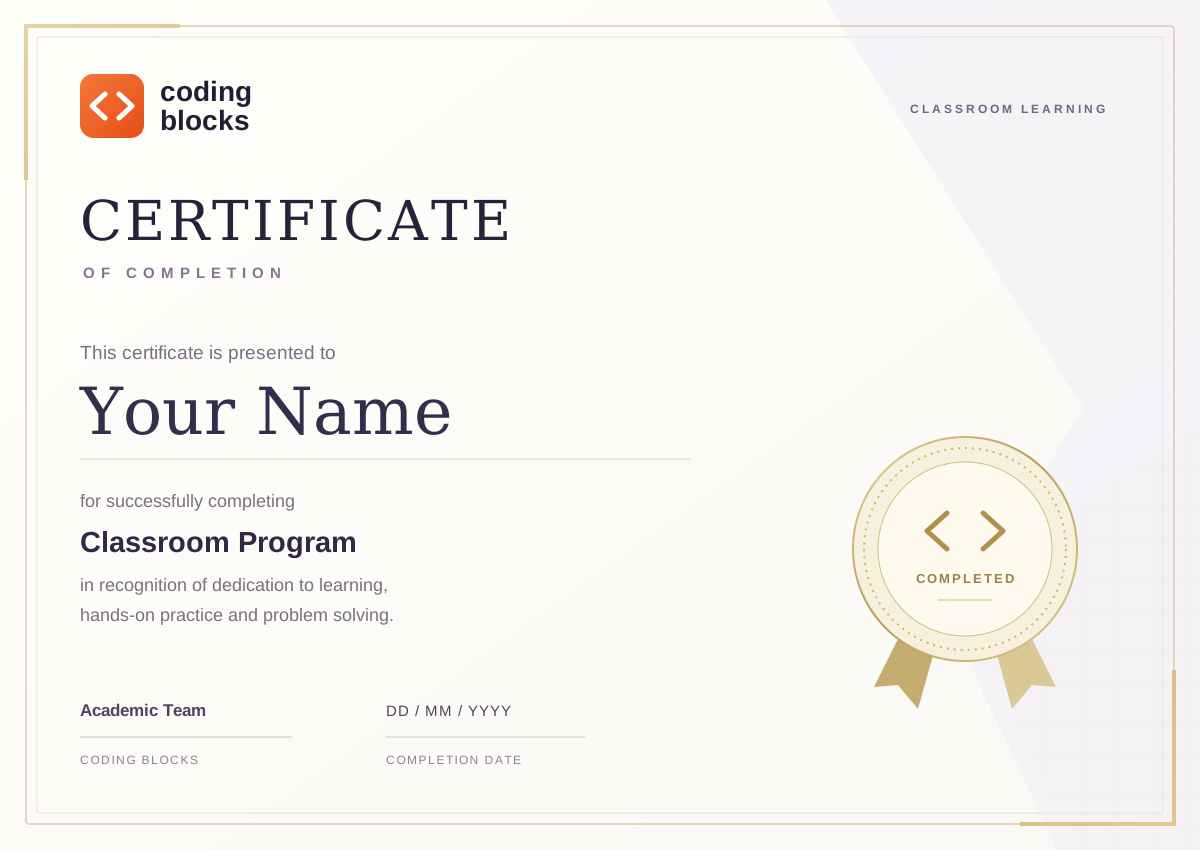
Celebrate the work you put into competitive programming with a Coding Blocks certificate of completion. Add it to your portfolio and share a milestone in your learning journey. Ask your advisor about the completion criteria for your batch.
  • A record of your completed program
  • A meaningful addition to your portfolio
  • A milestone to share with your network
Explore the curriculum
Coding Blocks certificate of completion, with space for your name, live program and completion date.
Coding Blocks certificate of completion
HOW LIVE CLASSES WORK

Learn live.
From wherever you are.

Join scheduled sessions with a mentor and your batch, ask questions in real time, and keep learning without a commute.

Live, not recorded

Real-time sessions with your batch

LIVE ONLINE
  • Scheduled live sessions

    Attend classes at fixed weekday or weekend timings with your mentor.

  • Ask as you learn

    Raise doubts in the session and get answers while the topic is fresh.

  • Learn with a batch

    Practise, discuss and keep pace alongside peers on the same roadmap.

Recordings and doubt support: confirm with your advisor Find a live batch

What you need

A simple setup is enough

LIVE ONLINE
  • A laptop or desktop

    To write and run code during sessions and assignments.

  • A stable internet connection

    Enough to stream video and share your screen.

  • A quiet space

    So you can listen, speak and focus for the full session.

Your next breakthrough
starts with deliberate practice.

Let’s find a Competitive Programming batch that fits where you are and where you want to go.

YOUR Competitive Programming ROADMAP

Get the complete syllabus.

Share your details, verify your email, and download your curriculum.

  1. Your details
  2. Verify email
  3. Download
ONE MORE LOOK BEFORE YOU JOIN

Your live class. Your batch.

Review your schedule and mentor before continuing.

Competitive Programming

Start date
Class days
Class time
Mentor
Duration
Course fee
Questions? Talk to our team