Work with real data
Prepare, explore and visualise data with Python, Pandas and SQL.
Build a foundation in data science and machine learning, then explore how AI agents use tools and context to handle multi-step tasks, and learn to evaluate what they produce.
Tell us a little about yourself.
Complete your syllabus request in the open window.
Build more than familiarity with syntax. Learn how to approach an unfamiliar problem, reason about your choices, and turn your thinking into working code.
For students and working professionals starting out in data science, or anyone ready to build intelligent systems with data and AI.
Prepare, explore and visualise data with Python, Pandas and SQL.
Train machine learning models and measure them with the metrics that fit the problem.
Build agent workflows that use tools and context, then test their output for quality and limitations.
Move from Python and statistics to machine learning and AI agents. Build the fundamentals to understand, test and improve what models and agents produce.
AI can help you write code. Programming knowledge and logical thinking help you ask better questions, spot incorrect assumptions, debug generated code and judge a solution’s efficiency. Learn the fundamentals so you can build with AI and understand the result.
Keep the module breakdown, practice assignments and learning outcomes.
Suggested curriculum. Confirm the current batch syllabus, module allocations and total duration with an advisor.
Python is the language that we use for scripting and learning Data Science algorithms throughout the course. This section provides a introduction to the basics of Python programming language. Python Basics includes Python Syntax, Output, Comments, Variables, Data Types, Numbers, Casting, Strings, Booleans, Operators, If...Else, Match, While Loops, For Loops, Range, and String Formatting. These topics help learners understand the foundation of Python programming.
Write small Python programs using variables, conditions and loops.
Write clean, readable Python for everyday tasks.
Functions are the programming paradigm that increases code reusability in our scripts. This section introduces functions in Python along with other high level concepts like Generators and Decorators.
Refactor repeated code into functions, generators and decorators.
Structure scripts into reusable, well-defined functions.
Data Structures are the skeleton of computer programming. Python In-Built Data Structures include Python Lists, Tuples, Sets, Dictionaries, and Arrays. These topics focus on storing, managing, and manipulating data in different formats.
Solve data-handling problems with lists, sets and dictionaries.
Pick the right built-in structure for each data task.
OOP includes Python Classes, OOP concepts, Classes/Objects, init Method, self Parameter, Class Properties, Class Methods, Inheritance, Polymorphism, Encapsulation, and Inner Classes. These topics teach how to build programs using objects and real-world models.
Model a real-world system with classes and inheritance.
Design programs using object-oriented principles.
In this section, we look into file handling with python. We also learn how to safely handle errors in our python programs.
Build a script that reads, writes and safely processes files.
Handle files and runtime errors without crashing programs.
In this section, we look back to functions and learn Generators in detail. We see the iteration protocol in python and implement different iterators in python.
Implement custom iterators and generator pipelines.
Process data lazily and efficiently with generators.
Basics of Machine Learning includes Introduction to Machine Learning, Roadmap to Learning Machine Learning, and Types of Data and Variables in ML. It also covers Data Cleaning techniques such as identifying and handling missing values, One Hot Encoding, Label Encoding, Ordinal Encoding, Outlier Detection and Removal, Feature Scaling using Standardization and Normalization, and handling duplicate data. These topics help learners prepare clean, structured, and high-quality data for building accurate machine learning models.
Clean, encode and visualise a raw real-world dataset.
Prepare high-quality data for machine learning models.
This section introduces us to Optimisation methods. Also this also introduces some of the basic loss function that we will use and their derivation.
Derive common loss functions and apply gradient descent by hand.
Understand the maths that drives model optimisation.
Linear Regression is one of the widely used algorithm in data analytics and data science firms. In this section we learn Linear Regression and its in-depth analogies.
Implement linear regression from scratch and compare with scikit-learn.
Explain and apply linear regression with confidence.
Learn how to map out any straight line i.e. linear in nature with any slope and constant using Linear Regression.
Build a predictor that learns any straight line from data.
Turn regression theory into a working project.
Linear Regression is one of the widely used algorithm in data analytics and data science firms. In this section we learn Linear Regression and its in-depth analogies.
Train a regression model on multiple input features.
Model outcomes that depend on many variables.
Learn to predict the pricing of any house in your neighbourhood according to realistic factors like size of land, vintage, industry etc. using Multivariate Linear Regression.
Predict Boston house prices from realistic property features.
Build and evaluate a multivariate prediction model.
How about a Linear model for classification tasks? This section, we learn Logistic Regression and see how classification is performed in Machine Learning.
Classify data points using logistic regression.
Apply linear models to classification problems.
Learn how to predict the chances of survival of any passenger present in the Titanic ship that is about to sink using all the features and the meta data.
Predict passenger survival on the Titanic dataset.
Build an end-to-end classification project.
Supervised Machine Learning includes Train-Test Split in datasets, Regression Analysis such as Simple Linear Regression, Multiple Linear Regression, and Polynomial Regression, along with Cost Function, R Squared Score, and Adjusted R Squared for performance evaluation. It also covers Classification techniques including Logistic Regression for Binary and Multiclass problems, Confusion Matrix, handling imbalanced datasets, and the Naive Bayes algorithm. In addition, it includes Non-Linear Supervised Algorithms such as Decision Tree for Classification and Regression, K-Nearest Neighbors for Classification, Hyperparameter Tuning, and Cross-Validation for improving model accuracy and reliability.
Train, tune and cross-validate regression and classification models.
Choose and evaluate supervised models for real problems.
Unsupervised Machine Learning includes concepts of Unsupervised Learning and Clustering techniques such as K-means Clustering, Hierarchical Clustering, and DBSCAN Clustering Algorithm. It also covers the Silhouette Score for evaluating clustering performance and measuring the quality of clusters. These methods help in discovering hidden patterns and structures in unlabeled data.
Segment unlabeled data using multiple clustering algorithms.
Discover hidden patterns in unlabeled data.
Ensemble Learning in Machine Learning includes the concept of Ensemble Learning and techniques such as Max Voting, Averaging, and Weighted Average Voting for combining multiple models. It also covers Bagging methods using the Bagging Meta-Estimator and Random Forest algorithm to improve prediction accuracy, reduce overfitting, and build more reliable machine learning models.
Combine models with voting, bagging and random forests.
Improve accuracy and reduce overfitting with ensembles.
Deep Learning covers Perceptrons including Single Layer and Multilayer Perceptrons, loss functions such as Hinge Loss and Binary Cross Entropy. It includes Artificial Neural Networks with training techniques like Vanishing and Exploding Gradients, Dropout, Early Stopping, and L1/L2 Regularization, Normalization, and Optimizers such as Exponential Moving Average, SGD with Momentum, AdaGrad, and Adam. It explains Convolutional Neural Networks including convolution, padding, strides, backpropagation, and transfer learning. It also includes Recurrent Neural Networks, their types and challenges, LSTM and Transformers and Attention Mechanisms including encoder-decoder architecture, positional encoding.
Train ANNs, CNNs and LSTMs on real datasets.
Build and tune deep learning models for varied data.
SQL covers Introduction to SQL, SQL Data Types, Database and Table Management, and Data Manipulation Language for working with data. It includes SQL Clauses for query refinement, SQL Operators, SQL Functions, and SQL Joins and Subqueries for combining and analyzing data. This section also covers SQL Window Functions along with practical problem-solving.
Write queries, joins and window functions on a sample database.
Extract and analyse data with SQL.
Mathematics for Data Science covers Introduction to Statistics including Population and Sample concepts, Descriptive and Inferential Statistics, and Basic Statistical Measures. It includes Measures of Central Tendency such as Mean, Median, and Mode, Measures of Variability, Percentages, Percentiles, and Quartiles. This section also covers Probability, Probability Distributions, Normal Distribution, Covariance, and Correlation. Additionally, it includes the Central Limit Theorem and Hypothesis Testing methods such as Confidence Intervals, t-test, Chi-square test, and ANOVA test.
Apply statistical tests to answer questions about a dataset.
Draw sound, evidence-based conclusions from data.
Generative AI covers concepts such as LangChain and Retrieval-Augmented Generation (RAG) pipelines. This section focuses on building intelligent applications by integrating large language models with external data sources, enabling context-aware responses, document retrieval, and end-to-end AI-powered workflows.
Build a simple RAG pipeline with LangChain.
Connect LLMs with external data sources.
NLP covers text preprocessing and normalization, regular expressions (Regex), tokenization, stemming and lemmatization, stop-word removal, Bag-of-Words (BoW), TF-IDF, N-Grams, word embeddings (Word2Vec, GloVe, FastText), sentiment analysis, intent classification, sequence modeling using RNNs, LSTMs, and GRUs.
Build a sentiment or intent classifier from raw text.
Process and model natural language data.
LLMs covers Transformer architecture, Self-Attention, Multi-Head Attention, Positional Encoding, BERT and GPT architectures, tokenization, pretraining vs. fine-tuning, basic LoRA, and running local LLMs using Ollama.
Run and fine-tune a local LLM with Ollama and LoRA.
Understand how transformer-based LLMs work and adapt.
Covers Generative AI fundamentals, foundation models, prompt engineering (Zero-Shot, Few-Shot), system prompts, temperature and Top-P, structured outputs (JSON, Pydantic), function/tool calling, multimodal inputs, and API integration with LLMs.
Build an LLM app with structured outputs and tool calling.
Write effective prompts and integrate LLM APIs.
Covers Text embeddings, cosine similarity, vector databases (ChromaDB), semantic search, metadata filtering, hybrid search (BM25 + vectors), document parsing, text chunking, RAG pipelines, reranking, source citations, and a Document Question-Answering Chatbot project.
Build a document question-answering chatbot with source citations.
Design retrieval pipelines with vector databases.
Agentic AI foundation covers AI agents, perception, memory, planning, task decomposition, ReAct (Reasoning and Acting), custom tools using Python functions and APIs, self-correction, error handling, retries, and Human-in-the-Loop (HITL) approval.
Build an agent that plans, calls custom tools and self-corrects.
Design reliable AI agents with human oversight.
LangChain and LangGraph fundamentals, stateful workflows, StateGraph, conditional routing, checkpoints and persistence, basic multi-agent collaboration, MCP (Model Context Protocol) fundamentals, prompt injection defense, and basic agent evaluation using Ragas or DeepEval.
Build a stateful multi-agent workflow with LangGraph.
Orchestrate, secure and evaluate AI agents.
Build a retail analytics system using PostgreSQL or MySQL to analyze customer lifetime value (CLV), purchase patterns, sales trends, and monthly customer retention cohorts. Apply database schema design, advanced SQL queries, CTEs, and window functions to generate business insights.
Analyse customer lifetime value and retention cohorts with SQL.
Turn transactional data into business insights.
Analyze more than a century of Olympic records to identify top-performing countries, medal trends, athlete achievements, and performance patterns. Use SQL aggregations, recursive CTEs, ranking functions such as DENSE_RANK, and LAG/LEAD to perform historical data analysis.
Investigate a century of Olympic records with advanced SQL.
Perform historical analysis with ranking and window functions.
Build a modular Python ETL application that extracts data from CSV and JSON files, validates schemas, handles missing or malformed records, transforms data, and exports cleaned datasets with audit logs. Apply OOP, Pydantic validation, logging, command-line interfaces, and unit testing with pytest.
Build a tested, modular ETL pipeline with validation and logging.
Write production-style Python data pipelines.
Develop a machine learning model to identify fraudulent credit card transactions in highly imbalanced datasets. Perform exploratory data analysis, feature engineering, class imbalance handling, and model evaluation using precision, recall, F1-score, and Precision-Recall AUC. Use scikit-learn, pandas, NumPy, and imbalanced-learn.
Detect fraud in a highly imbalanced transaction dataset.
Evaluate models where precision and recall matter most.
Build a multi-class classification model that predicts possible disease categories from structured symptom data. Perform data preprocessing, feature selection, decision tree classification, ensemble modeling, and cost-complexity pruning. Evaluate performance using confusion matrices, classification reports, and feature importance analysis.
Predict disease categories from structured symptom data.
Build and interpret multi-class tree-based models.
Develop a deep learning model to classify chest X-ray images for pneumonia detection. Apply image preprocessing, data augmentation, convolutional neural networks, transfer learning, and model evaluation with a focus on sensitivity and false-negative reduction. Use PyTorch or TensorFlow/Keras, torchvision, and OpenCV.
Classify chest X-rays for pneumonia with transfer learning.
Apply CNNs to real medical imaging problems.
Use the sensor data from accelerometers and gyroscopes to classify activities such as walking, resting, and climbing stairs. Learn time-series preprocessing, sliding-window techniques, LSTM models, and performance evaluation.
Classify human activities from accelerometer and gyroscope data.
Model time-series data with LSTMs.
Build a document-based AI Study Assistant using Python, an LLM API, and LangChain. The application should accept study notes or a document, answer questions using the provided content through a basic RAG pipeline, generate a short quiz, and provide relevant source references. Test the application for answer accuracy and handle questions that cannot be answered from the document.
Build a study assistant that answers questions and generates quizzes.
Ship a document-grounded LLM application.
Build a chatbot that answers questions from multiple PDF documents. Learn document extraction, text chunking, embeddings, vector databases, semantic search, and RAG pipelines to generate answers based on the uploaded documents, with relevant source citations.
Build a chatbot that answers questions across multiple PDFs.
Build multi-document RAG with source citations.
Building an AI assistant integrating RAG, tool calling, LangGraph workflows, MCP-based tool integration, conversation memory, safety guardrails, and FastAPI deployment.
Build and deploy an agentic AI assistant with FastAPI.
Ship an end-to-end agentic AI system.
Go beyond isolated exercises. These project ideas bring your data, models and agents together in something you can build, evaluate and explain.
Ask a question in plain language, let the agent plan and run the analysis with tools, and check every step it took.
Run an agent against a set of test cases and score its answers for accuracy, grounding and reliability.
Rank useful suggestions from user and item data, and compare how different models perform.
Explore retention signals, predict which customers are likely to leave, and explain what drives each prediction.
Organise incoming documents by topic, and inspect model confidence before you trust a label.
Illustrative project previews. Your mentor will confirm project scope and review criteria for your batch.
A learning rhythm that connects the concept, the code and your reasoning. Here’s how you can turn each new topic into a skill.
Walk through the idea and trace examples. Understand when an approach works and where it falls short.
Work through notebooks and assignments. Train models, test agents, and try the next variation.
Explain your approach, compare alternatives, and connect your results to the metrics that matter.
Ask your advisor about assignment reviews, doubt support, recordings and mock interview inclusions for your chosen batch.
Choose the environment that suits your routine. Our advisors can help you compare current batches, schedules and support.
Bring your questions to class, learn alongside peers, and build a routine around in-person sessions.
Explore Noida & NSP centres Find a classroom batchAttend live sessions remotely. Find a batch whose timing and learning support work for your day.
Live sessions · learn remotely Explore live batchesApply for CAST — the Coding Blocks Aptitude and Scholarship Test — and earn a scholarship of up to 100% on course fees.
Available for classroom and Live interactive courses, including Sampoorna. Awards are subject to the test’s eligibility and award terms.
Choose NSP or Noida, then find the weekday or weekend schedule that fits you.
No batches are currently listed for this selection. Contact our team about the next intake.
Talk to an advisorThe suggested curriculum starts with Python and data foundations before moving into statistics, machine learning and AI agents. It is designed for students starting out in data science or strengthening their fundamentals. Tell your advisor about your experience to check your starting point.
Choose classroom learning if you prefer an in-person routine and peer interaction. Live learning lets you attend remotely. Ask about current Data Science with Agentic AI batch availability, timings and support before choosing your mode.
The suggested roadmap includes topic exercises, practical assignments, timed problem sets and project ideas such as a data analysis agent and a customer churn lab. Your mentor will confirm project scope, review criteria and the curriculum for your batch.
The course duration is 6 months. Contact an advisor for the current start date, class schedule and fees for your selected batch and learning mode.
Mentor allocation and support are confirmed with your selected batch. Ask your advisor about doubt sessions, assignment reviews, recording access and mock interview inclusions before enrolling.
Meet Coding Blocks learners whose practice and persistence led to opportunities at leading companies.


















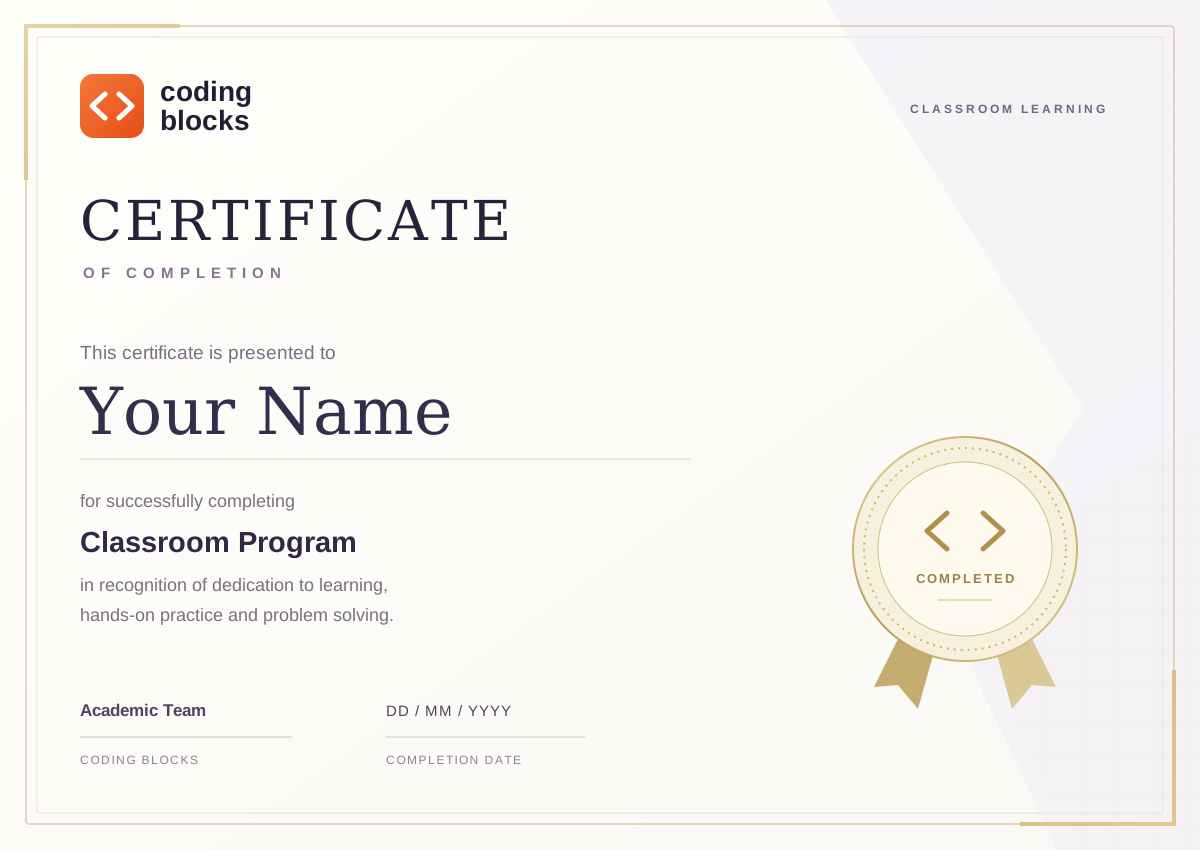
Celebrate the work you put into data science and agentic AI with a Coding Blocks certificate of completion. Add it to your portfolio and share a milestone in your learning journey. Ask your advisor about the completion criteria for your batch.
Learn with us in Noida or Netaji Subhash Place, Delhi. Find the centre that fits your commute, get directions and come meet the team.
Sector 2 · Uttar Pradesh
Netaji Subhash Place · Pitampura
Let’s find a Data Science batch that fits where you are and where you want to go.
Starts