Scope before you build
Turn vague requirements into clear goals, estimate capacity, and define the API contracts a system must honour.
Turn requirements into scalable systems. Learn to choose the right building blocks for data, services and reliability, and explain the tradeoffs behind every decision.
Tell us a little about yourself.
Complete your syllabus request in the open window.
Build more than familiarity with syntax. Learn how to approach an unfamiliar problem, reason about your choices, and turn your thinking into working code.
For students and working professionals who can program and understand basic web applications, and want to design systems that scale.
Turn vague requirements into clear goals, estimate capacity, and define the API contracts a system must honour.
Pick storage, caching, queues and load balancing that fit the workload. Understand what makes a system scale.
Walk through your design, plan for failure, and explain the consistency, latency and cost decisions that matter.
Move from requirements and estimation to the building blocks behind scalable systems. Build the design thinking to evaluate and improve an architecture—even when AI helps draft it.
AI can help you write code. Programming knowledge and logical thinking help you ask better questions, spot incorrect assumptions, debug generated code and judge a solution’s efficiency. Learn the fundamentals so you can build with AI and understand the result.
Keep the module breakdown, practice assignments and learning outcomes.
Suggested curriculum. Confirm the current batch syllabus, module allocations and total duration with an advisor.
Trace a full request from browser to server.
Explain how the web works end to end.
Compare monolithic and microservice designs for one application.
Choose architectural patterns based on trade-offs.
Analyse the CAP trade-offs of real distributed systems.
Reason about consistency, availability and fault tolerance.
Define functional and non-functional requirements for a system.
Translate requirements into design goals.
Estimate load and capacity for a high-traffic application.
Identify bottlenecks and plan for scale.
Design a horizontally scalable service behind a load balancer.
Scale applications and choose suitable databases.
Design indexing, replication and sharding for a database.
Scale and manage data reliably.
Choose communication protocols for a set of services.
Design synchronous and asynchronous service communication.
Compare rendering and caching strategies for a web application.
Choose rendering, CDN and caching strategies.
Design a scalable URL shortener.
Apply ID generation, caching and scaling techniques.
Design a Pastebin service with expiring links.
Design storage and expiry for user content.
Design a distributed rate limiter with Redis.
Compare and apply rate-limiting algorithms.
Design a low-latency autocomplete service.
Design fast, ranked search suggestions.
Design a video upload and streaming platform.
Design scalable media processing and delivery.
Design a file sync and storage service.
Design storage, sync and versioning systems.
Design a distributed web crawler.
Design scalable, polite crawling systems.
Design an end-to-end system from requirements to architecture.
Present and defend a high-level design.
Model a small system using classes and SOLID principles.
Write object-oriented designs that are easy to change.
Apply design patterns to a real design problem.
Choose the right design pattern for each problem.
Design the classes for a meeting scheduler.
Model scheduling and availability logic.
Design an extensible task planner.
Model entities and relationships cleanly.
Build a bowling score calculator using test-driven design.
Turn rules into tested, well-modelled code.
Build a Snakes and Ladders game with clean class design.
Model game state and rules with objects.
Design a nested comment system.
Model hierarchical, extensible data.
Design a sales and inventory management application.
Design object-oriented business applications.
Design a movie ticket booking system with seat locking.
Handle concurrency in booking workflows.
Make a design thread-safe and refactor it for quality.
Write concurrent, maintainable code.
Complete a timed machine coding exercise.
Approach LLD interviews with a clear process.
Go beyond isolated concepts. These project ideas bring storage, scale and reliability together in designs you can sketch, stress-test and explain.
Generate short links, route reads through a cache, and estimate the storage and traffic the service must handle.
Protect an API from overload, compare token bucket and sliding window approaches, and test the limits.
Partition a city into grid cells, index moving drivers, and match riders to the nearest one in real time.
Route messages through queues, prioritise urgent work, and keep delivery reliable with retries and idempotency.
Return suggestions as the user types, cache popular prefixes, and keep latency low under heavy reads.
Illustrative project previews. Your mentor will confirm project scope and review criteria for your batch.
A learning rhythm that connects the concept, the code and your reasoning. Here’s how you can turn each new topic into a skill.
Walk through the idea and trace examples. Understand when an approach works and where it falls short.
Sketch architectures, estimate capacity, and stress-test your design against scale and failure.
Explain your approach, compare alternatives, and connect your design to its tradeoffs.
Ask your advisor about assignment reviews, doubt support, recordings and mock interview inclusions for your chosen batch.
Choose the environment that suits your routine. Our advisors can help you compare current batches, schedules and support.
Bring your questions to class, learn alongside peers, and build a routine around in-person sessions.
Explore Noida & NSP centres Find a classroom batchAttend live sessions remotely. Find a batch whose timing and learning support work for your day.
Live sessions · learn remotely Explore live batchesApply for CAST — the Coding Blocks Aptitude and Scholarship Test — and earn a scholarship of up to 100% on course fees.
Available for classroom and Live interactive courses, including Sampoorna. Awards are subject to the test’s eligibility and award terms.
Choose NSP or Noida, then find the weekday or weekend schedule that fits you.
No batches are currently listed for this selection. Contact our team about the next intake.
Talk to an advisorThe suggested curriculum assumes you can program in at least one language and understand basic web applications. It starts with design foundations such as requirements, capacity estimation and API contracts before moving into storage, scale and reliability. Tell your advisor about your experience to check your starting point.
Choose classroom learning if you prefer an in-person routine and peer interaction. Live learning lets you attend remotely. Ask about current System Design batch availability, timings and support before choosing your mode.
The suggested roadmap includes design assignments, case studies and project ideas such as a URL shortener and a messaging architecture. Your mentor will confirm project scope, review criteria and the curriculum for your batch.
These depend on your selected batch and learning mode. Contact an advisor for the current start date, class schedule, total duration and fees.
Mentor allocation and support are confirmed with your selected batch. Ask your advisor about doubt sessions, assignment reviews, recording access and mock interview inclusions before enrolling.
Meet Coding Blocks learners whose practice and persistence led to opportunities at leading companies.



















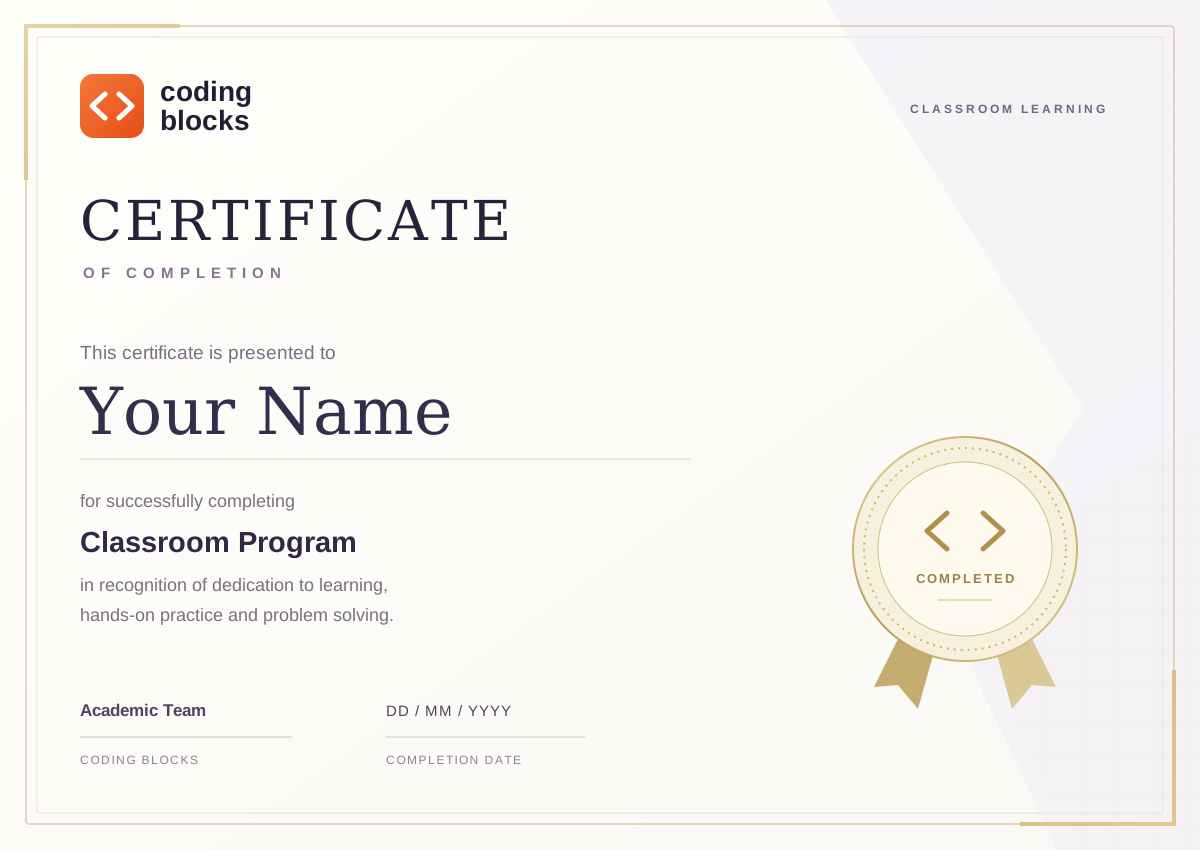
Celebrate the work you put into system design with a Coding Blocks certificate of completion. Add it to your portfolio and share a milestone in your learning journey. Ask your advisor about the completion criteria for your batch.
Learn with us in Noida or Netaji Subhash Place, Delhi. Find the centre that fits your commute, get directions and come meet the team.
Sector 2 · Uttar Pradesh
Netaji Subhash Place · Pitampura
Let’s find a System Design batch that fits where you are and where you want to go.
Starts